Clinique Renewing Powder Cleanser With Pure Vitamin C
(Image credit: Future)
The Clinique Cyber Monday and Black Friday event is one of those beauty sales that makes for very wise cyber weekend shopping indeed. Why? Because the smartest sale buys are staples that you genuinely need rather than flash in the pan nonsense you don't—and Clinique is a brand that does staples better than most.
This year's Clinique Cyber Monday deals follow on from the unmissable Black Friday sales that took place towards the end of last week and over the weekend. As well as half-price offers on selected beauty sets—perfect for holiday gifting—the brand also has a generous 25% discount across products we all know and love such as Dramatically Different Moisturizing Lotion, High Impact Mascara, and Moisture Surge 100H Auto-Replenishing Hydrator.
Plus, with retailers such as Selfridges, Boots, Look Fantastic, Nordstrom and Sephora offering their own Clinique Cyber Monday deals, now's the ideal time to stock up on your favorite skincare and makeup buys and snare a cheeky discount into the bargain.
Clinique Cyber Monday—all the best deals
We've laid out all of the best places to snap up a Clinique Cyber Monday offer today—and have picked out some of our favorite deals too...
The best Clinique Cyber Monday deals in the UK
Boots: Clinique's Best Skincare and Makeup Gift Sets with 50% off
Clinique Half price sets and 25% off bestsellers in the Clinique Cyber Monday sale
Feelunique Up to £42 off Clinique makeup and fragrance gift sets
Look Fantastic: Save an extra 10% on their 20% sale with the code 'CYBER'
Selfridges Save 10% across all Clinique products with code 'SELFCCE'
Clinique Cyber Monday deals in the UK
The best Clinique Cyber Monday deals in the US
Macy's: Cyber Monday special discounts across Clinique makeup skincare and more
Nordstrom: 30% off across best-selling skincare products
Selfridges: Save 10% on Clinique with code 'SELFCCE'
Sephora: Get up to 50% off on Clinique fan favorites
Ulta: Free gift with purchase when you spend $35 on Clinique
Clinique Cyber Monday deals in the US
These deals are already well underway and the hero products are unlikely to hang around for much longer—so we'd snap up anything you have your eye on pretty soon as we don't expect these Clinique Cyber Monday special offers will be around for long after today.
As woman&home's Beauty Channel Editor, Fiona Mckim has tried more beauty products than she's had hot dinners and nothing makes her happier than raving about a brilliant find on womanandhome.com or her instagram grid (@fionamckim if you like hair experiments and cute shih-tzus)
Fiona joined woman&home as Assistant Beauty Editor in 2013, working under industry legend Jo GB, who taught her everything she needed to know (clue: learn about ingredients and employ extreme cynicism).
In a previous life, Fiona studied journalism back home in bonnie Scotland and honed her skills as a features writer at publications including Junior and Prima Baby, with a brief and terrifying stint on the showbiz pages of a tabloid newspaper in between. She's a skincare fanatic who can't resist adding an extra step to her routine, adores fragrance, has fun with makeup and never turns down the chance to test a new hair tool. Basically, she loves it all.
When not slathering herself in self tan or peering at a tiny ingredients list on a moisturiser, you'll probably find Fiona enjoying something to do with food - cooking it, eating it, cajoling her friends into trekking across London to try a hyped pop-up in a dirty car park.
Come to think of it, the hot dinners and beauty products are probably about even.
Measure the vitamin C content of a sample of fruit juice by measuring the volume of the sample required to decolourise a solution of DCPIP. Calibrate the results by comparison with a known concentration of vitamin C.
Demonstrate the effect of vitamin C on DCPIP. Get students to test 2 or 3 of the juices you provide to practise the technique. Ask students to develop a hypothesis to test, and to investigate it systematically. Your classroom organisation may depend on the equipment you have available. A burette of DCPIP may be the focal point for each working group.
The chemicals used in this investigation are LOW HAZARD (Notes 1 and 2).
1 Vitamin C solution: See CLEAPSS Hazcard. CLEAPSS Recipe card recommends a concentration of 0.1%; this protocol suggests 1%. This solution is LOW HAZARD.
2 DCPIP (2,6-dichlorophenol-indophenol) is LOW HAZARD; see CLEAPSS Hazcard. CLEAPSS Recipe card recommends a concentration of 0.1%; this protocol suggests 1% so dissolve 1.0 g of dye in 100 cm3 of water.
Ethical issues
There are no ethical issues with this procedure. Consider what to do if your results give very different measures than those quoted by manufacturers.
Procedure
SAFETY: Take care with fragile glassware such as burettes.
Preparation a Make up a 1% solution of vitamin C with 1 g of vitamin C in 100 cm3; this is 10 mg cm–3.
b Make up a 1% solution of DCPIP.
Investigation
c Pipette 2 cm3 of vitamin C solution into a test tube.
d Using a graduated pipette or a burette, add 1% DCPIP drop by drop to the vitamin C solution. Shake the tube gently after adding each drop. Add DCPIP solution until the blue colour of the final drop does not disappear.
e Record the exact amount of DCPIP solution that was added.
f Repeat the procedure and calculate an average result.
g Repeat with the fruit juices to be tested. If more than 5 cm3 of DCPIP are completely decolourised, dilute the fruit juice and repeat the test. If the fruit juice has a strong colour that will interfere with determining the end point, dilute the juice before testing.
h Calculate the amount of vitamin C in the standard solution in mg cm–3. Calculate how much vitamin C there is in each of the fruit juices in mg cm–3.
Teaching notes
In acidic conditions, DCPIP does not decolourise completely, but remains pink. With strongly acidic juices such as lemon juice this could confuse determination of the endpoint.
If you are testing lots of different solutions, it is easier to put the DCPIP in a burette and titrate it into measured samples of fruit juice, rather than cleaning a burette several times in one lesson. If you have plenty of graduated pipettes, you could measure each juice into a measured sample of DCPIP and observe the point at which the DCPIP loses its colour.
Hypotheses to test could include…
fresh juices have more vitamin C than long-life
juice 'not from concentrate' is best in terms of vitamin content
fruit squashes have less vitamin C than fruit juices
if heat destroys vitamin C, then heat-treated long-life juices will have lower concentrations
if heat destroys vitamin C, then boiled fruit juice will have lower concentrations than unboiled
manufacturers generally provide reliable information about their products
vitamin C degrades in vitamin tablets, and old tablets will have less than fresh ones
Health and safety checked, September 2008
Downloads
Download the student sheet Measuring the Vitamin C content of foods and fruit juices (56 KB) with questions and answers.
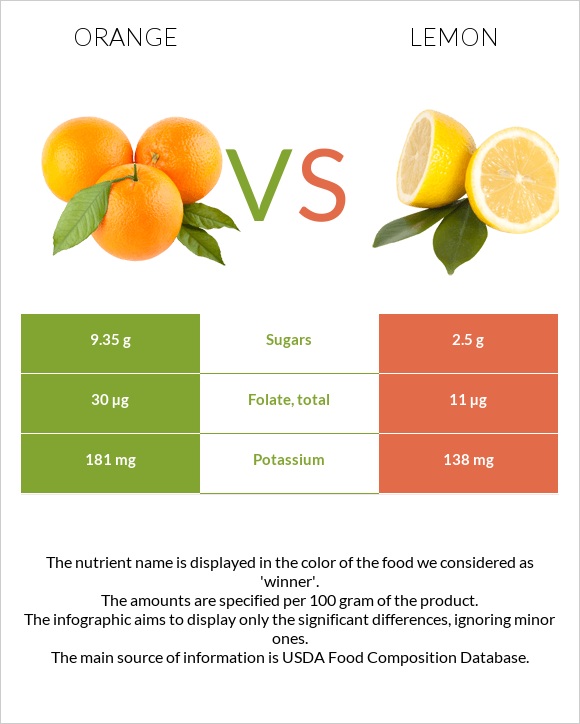
Oranges contain more calories and carbohydrates due to sugars, and lemons are richer in protein, fats, and fiber. The two are similar in the amounts of vitamin C.
Oranges overall are richer in both vitamins and minerals, containing more vitamin A, vitamin E, vitamins B1, B2, B3, B5, and B9, as well as calcium, potassium, magnesium, copper, and zinc. Lemons, on the other hand, contain higher concentrations of vitamin B6, iron, and phosphorus.
Both possess cardioprotective, antidiabetic, anticancer, and antimicrobial qualities.
Both oranges and lemons can be very beneficial if used correctly, and the choice depends on the situation and personal preference.
Table of contents
Introduction
Nutrition
Vitamins
Vitamin C
Minerals
Health Impact
Cardiovascular Health
Antioxidant Effects
Cardioprotective Effecfts
Antihypertensive Effects
Cerebrovascular Protection
Diabetes
Glucose and Insulin Response
Obesity
Diabetic Nephropathy
Cancer
Antimicrobial Effects
Allergy
Antiallergic Qualities
Sources.
Introduction
Oranges and lemons are often the fruits that come to mind when we think of good sources for vitamin C. They are both citrus fruits belonging to the Rutaceae family and the Citrus genus and both hybrids. A genomic study has shown that oranges (Citrus × sinensis) are a hybrid between pomelo and mandarin (1), whereas lemons are said to be a hybrid between sour (Seville, bitter or Citrus × aurantium) orange and citron (2). In this article, the word "orange" refers to the sweet orange or Citrus × sinensis, as it is the most commonly used species of oranges.
Nutrition
Oranges contain more calories and carbs due to sugar, while lemons are higher in protein, fats, and fiber. Both fruits naturally do not contain cholesterol.
When it comes to the glycemic index, both oranges, and lemons, as most citrus fruits, fall under the classification of low glycemic index foods.
While an exact number has not yet been calculated for the glycemic index of lemons, the glycemic index of raw oranges from Canada is 40.
You can find full texts on the glycemic impact of orange and lemon.
One serving size of an orange is equal to one fruit that weighs around 131g. Lemon's serving size is much smaller, equalling 58 grams.
If you are on a low-carb or a low-calorie diet, lemons are the right choice for you out of these two fruits. Orange is the preferable choice for a low-fat diet.
Acidity
Lemons often taste sourer than oranges. The fruit's acidity decides this difference in taste. The acidity of lemon varieties falls between 5 to 7%, primarily due to the citric acid content, as opposed to the 1% in oranges (3). The pH of oranges is calculated to be in the range of 3,69-4,34, whereas the pH of lemons is around 2 to 2,6 (4). The pH of lemon juice also ranges around the same numbers as the pH of a lemon. Therefore, lemons are more acidic than oranges.
Once oranges and lemons are fully digested and metabolized, the citric acid becomes alkaline in the body. Based on the potential renal acid load (PRAL), oranges are more alkaline-forming.
Vitamins
Oranges are overall richer in vitamins, being higher in vitamin A, vitamin E, vitamins B1, B2, B3, B5, and B9. The only vitamin that lemons contain more of is vitamin B6.
Both oranges and lemons lack vitamin D, vitamin K, and vitamin B12.
Vitamin C
Vitamin C is one of the most important nutrients found in citrus fruits, for which they are famous. Lemons and oranges have approximately the same amount of vitamin C, with orange's vitamin C content only slightly higher. Both oranges and lemons contain more vitamin C in their zests or peels.
However, raw lemon juice is richer in vitamin C compared to orange juice.
Vitamin Comparison
Vitamin comparison score is based on the number of vitamins by which one or the other food is richer. The "coverage" chart below show how much of the daily needs can be covered by 300 grams of the food
8
:
1
Contains moreVitamin A +922.7%
Contains moreVitamin E +20%
Contains moreVitamin B1 +117.5%
Contains moreVitamin B2 +100%
Contains moreVitamin B3 +182%
Contains moreVitamin B5 +31.6%
Contains moreFolate +172.7%
ContainsmoreVitamin B6 +33.3%
Contains moreVitamin A +922.7%
Contains moreVitamin E +20%
Contains moreVitamin B1 +117.5%
Contains moreVitamin B2 +100%
Contains moreVitamin B3 +182%
Contains moreVitamin B5 +31.6%
Contains moreFolate +172.7%
ContainsmoreVitamin B6 +33.3%
Minerals
Oranges also win in the minerals category. They contain higher concentrations of calcium, potassium, magnesium, copper, and zinc. Lemons, on the other hand, are much higher in iron and contain more phosphorus as well. Lemons also contain sodium, whereas oranges do not.
Mineral Comparison
Mineral comparison score is based on the number of minerals by which one or the other food is richer. The "coverage" chart below show how much of the daily needs can be covered by 300 grams of the food
6
:
2
Contains moreCalcium +53.8%
Contains morePotassium +31.2%
Contains moreMagnesium +25%
Contains moreCopper +21.6%
Contains moreZinc +16.7%
Contains lessSodium -100%
ContainsmoreIron +500%
ContainsmorePhosphorus +14.3%
Contains moreCalcium +53.8%
Contains morePotassium +31.2%
Contains moreMagnesium +25%
Contains moreCopper +21.6%
Contains moreZinc +16.7%
Contains lessSodium -100%
ContainsmoreIron +500%
ContainsmorePhosphorus +14.3%
Health Impact
Oranges and lemons, like all citrus fruits, are rich in phytochemicals that provide many protective qualities. These phytochemicals include flavonoids (naringenin, hesperidin), carotenoids (beta-carotin, lutein), coumarins, phenolic acids, and many others.
Cardiovascular Health
Antioxidant Effects
Reactive oxygen species are the chemicals often involved in heart disease. These are chemically reactive compounds that can be toxic to cells, damaging macromolecules, such as lipids, proteins, and nucleic acids. Phenolic compounds found in citrus fruits can directly absorb, neutralize these chemicals and inhibit enzymes associated with this pathogenesis. Polyphenols can also enhance the natural human antioxidants (5).
Cardioprotective Effecfts
Many studies have shown foods high in flavonoids to lower blood cholesterol and triglyceride levels. Lemons, in particular, have been shown to reduce low-density lipoproteins, commonly referred to as "bad cholesterol," and increase high-density lipoproteins, often called "good cholesterol" (6).
Flavonoids can also prevent hyperglycemia by increasing the formation of glycogen molecules from glucose and inhibiting the synthesis of glucose in the liver (5)․
Atherosclerosis is the leading cause of heart disease and stroke. Naringenin and hesperetin are flavonoids that also possess antiatherogenic abilities by promoting fatty acid breakdown. Oranges contain comparatively high levels of naringenin, whereas lemons are rich in hesperetin (7).
Antihypertensive Effects
People with high blood pressure are advised to decrease their sodium intake. Luckily oranges do not contain sodium, and lemons are low in this mineral.
A study has shown that high flavonoid juice consumption can reduce diastolic blood pressure due to flavonoids such as naringin and narirutin (8).
Intake of lemon has also been proven to have an inverse association with systolic blood pressure (9).
Cerebrovascular Protection
One research has concluded that citrus consumption reduces the risk of cerebrovascular diseases, such as ischemic stroke and intracerebral hemorrhage (10).
Diabetes
Glucose and Insulin Response
Studies in experimental diabetes models demonstrate the efficacy of citrus flavonoids to improve glucose tolerance, increase insulin secretion and sensitivity, decrease insulin resistance, reduce hepatic glucose production and intestinal glucose absorption, enhance peripheral glucose uptake, suppress inflammation, and modulate the activity of enzymes and transporters involved in glucose and lipid metabolism (11). The flavonoids with strong antidiabetic activities are hesperidin, naringin, and nobiletin (5)
Consuming lemon or lemon juice along with bread or other starchy foods has been proven to reduce the impact of glycemic response through premature inhibition of the α-amylase enzyme in the saliva that breaks down carbohydrates (12).
A study has also shown that 1000mg of vitamin C consumption a day leads to decreased levels of blood sugar, total cholesterol, triglycerides, low and high-density lipoproteins, as well as serum insulin (13).
Obesity
Citrus flavonoids modulate different signaling pathways involved in adiposity and fat cell differentiation and hence could be of significant value for the development of antiobesity agents (11).
Polyphenols found in citrus fruits can assist obesity management since they cause a reduction in fat cell differentiation, lipid content in the cell, and programmed death of fat cells. They can also potentially alleviate complications present in obesity by reducing cytokines, which are responsible for inflammatory processes (14).
Diabetic Nephropathy
Diabetic nephropathy is a severe complication due to diabetes mellitus type 2, which leads to end-stage renal disease. A study has concluded that red orange and lemon extract has the ability to prevent this complication, owing to the strong antioxidant qualities of anthocyanins (15).
Cancer
The phytochemicals within citrus fruits have been associated with a reduced risk of cancers, especially digestive and upper respiratory tract cancers. This effect was significant even with moderate citrus fruit consumption (16).
The phytochemicals that have shown anticancer abilities include flavonoids, limonenes, and coumarins. The effects have been studied against gastric cancer, breast cancer, formation of lung tumors, formation of tumors of the colon, hepatocarcinogenesis, and blood stem cell malignancies (5).
Lemons are particularly rich in limonenes, which have been studied to have antiproliferative effects on human breast cancer cells (17). This effect is stronger in estrogen-responsive breast cancers due to limonene's anti-aromatase quality, which inhibits androgens' transformation into estrogens.
Not only fresh citrus fruits but also their juices and other derivatives can act as a potential resource against various cancers (18).
Antimicrobial Effects
Essential oils of orange and lemon fruits have expressed bacteriostatic (stopping bacteria's reproduction) and bactericidal (killing the bacteria) effects, primarily due to the limonene concentration (7).
Another phytochemical naringenin, a flavonoid that oranges are especially rich in, has been shown to repress Salmonella bacterium's pathogenicity and cell motility (19). This flavonoid and some others may also modulate intestinal microflora by serving as an antipathogenic agent against Escherichia Coli (20).
Allergy
Citrus allergies are quite rare but do occur. A person allergic to citrus fruits may have symptoms shortly after coming in contact with fruits, such as oranges and lemons. An allergy to the compound called limonene can cause contact dermatitis (21). However, food allergies are more common, causing symptoms such as oral allergy syndrome (itching, swelling, tingling, or redness of the mouth area), nausea, diarrhea, and in rare cases, even anaphylaxis.
The allergens identified in citrus fruits are lipid transfer proteins, profiling, and pectin, as well as limonene. Some of these allergens may have cross-reactions with other common allergens, such as pollen, apples, or peaches (22, 23).
People can also be sensitive to citric acid, which is not considered to be an allergy, as citric acid does not cause an immune response in the organism (24).
Antiallergic Qualities
For allergic people who are not sensitive to citrus fruits, these fruits may serve as natural medicine. Flavonoids naringenin and hesperidin, which oranges and lemons are rich in, have been studied to reduce allergy symptoms and suppress inflammatory compounds (25).
Oral administration of aqueous extracts of citrus fruit peels has also been studied to demonstrate antiallergic and anti-inflammatory qualities (26).
The summary score is calculated by summing up the daily values contained in 300 grams of the product. Obviously the more the food fulfills human daily needs, the more the summary score is.
Vitamin Summary Score
24
20
Mineral Summary Score
8
9
Macronutrients Comparison
Macronutrient comparison charts compare the amount of protein, total fats, and total carbohydrates in 300 grams of the food. The displayed values show how much of the daily needs can be covered by 300 grams of food.
Protein
6%
7%
Carbohydrates
12%
9%
Fats
1%
1%
Which food is preferable for your diet?
is better in case of low diet
Low Calories diet
Low Fats diet
Low Carbs diet
Low glycemic index diet
People also compare
Comparison summary
Which food contains less Sodium?
Orange contains less Sodium (difference - 2mg)
Which food is lower in Saturated Fat?
Orange is lower in Saturated Fat (difference - 0.024g)
Which food is lower in glycemic index?
Orange is lower in glycemic index (difference - 45)
Which food is cheaper?
Orange is cheaper (difference - $0.1)
Which food is richer in vitamins?
Orange is relatively richer in vitamins
Which food is lower in Sugar?
Lemon is lower in Sugar (difference - 6.85g)
Which food contains less Cholesterol?
?
The foods are relatively equal in Cholesterol (0 mg)
Which food is richer in minerals?
?
It cannot be stated which food is richer in vitamins. See the charts below for detailed information. See the charts below for detailed information. See the charts below for detailed information.



 Measuring the Vitamin C content of foods and fruit juices (56 KB) with questions and answers.